
August 17, 2026
Paper Trail
Stand close enough to a Sabine Hertig collage and the picture comes apart. A face turns out to be a hundred small tears of newsprint; a shadow, on closer inspection, is the wing of an aeroplane pasted in at the wrong scale. Take two steps back and the picture reassembles itself, whole again, uncannily calm.
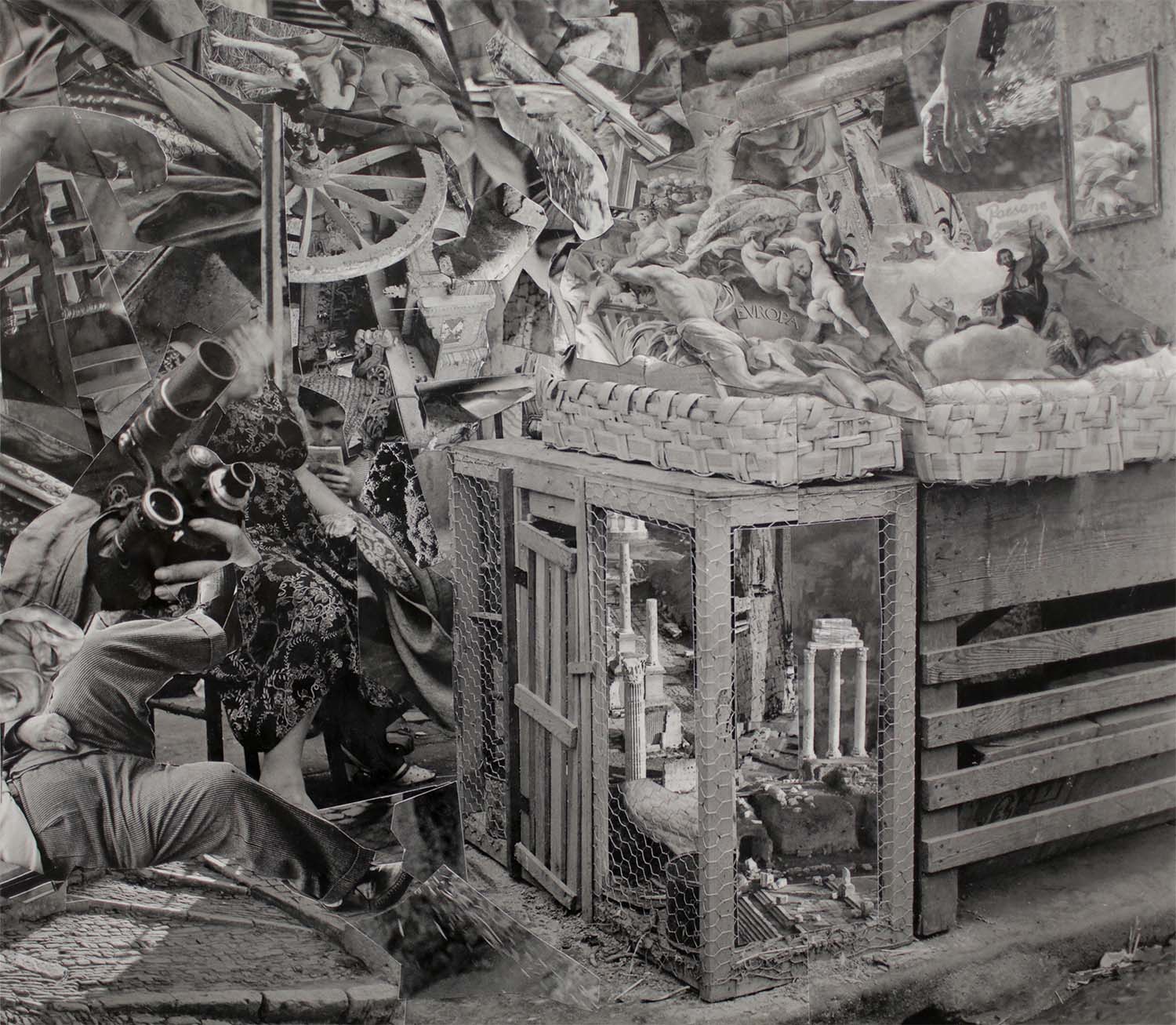
Sabine Hertig Untitled, 2025. Analogue collage on paper, 30 x 34.5cm © Sabine Hertig.
That flicker between chaos and order sits at the centre of Interfaces of Sight, which opens at Kunstmuseum Thun on 22 August and runs until 29 November. Conceived as a dialogue rather than a comparison, the show places Hertig’s work against that of Hans Gerber, a Swiss sculptor turned collagist who died in 1978, pairing an artist testing the medium’s outer limits today with one who spent two decades quietly writing its grammar. Gerber came to collage almost by accident. Trained as a sculptor, he moved to Lake Geneva in 1950 with his partner, the writer and illustrator Hans Walter, and it wasn’t until 1954 that he set sculpture aside for paper and glue.
He never fully let go of the sculptor’s instinct, instead adapted his collages to have the tautness of something built rather than arranged, forms locked into place with a precision that borders on the architectural. One series takes its title from the Italian word for prisons, an echo of Piranesi’s etched dungeons that the work doesn’t bother to explain.
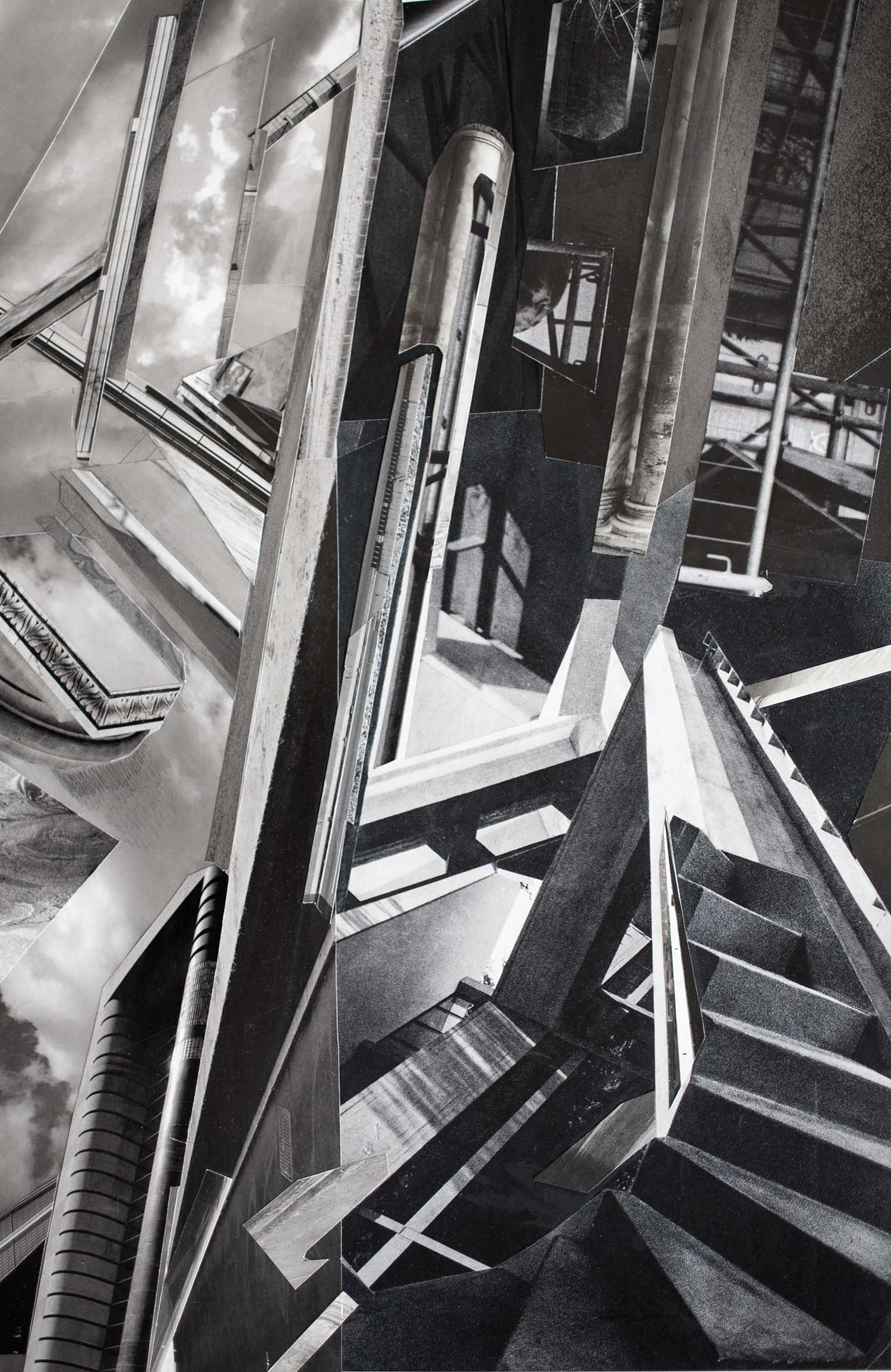
Sabine Hertig, Untitled (image extension of Hans Gerber’s collage 66 / 591), 2025. Analogue collage on paper, 40.5x 26 cm. © Sabine Hertig.
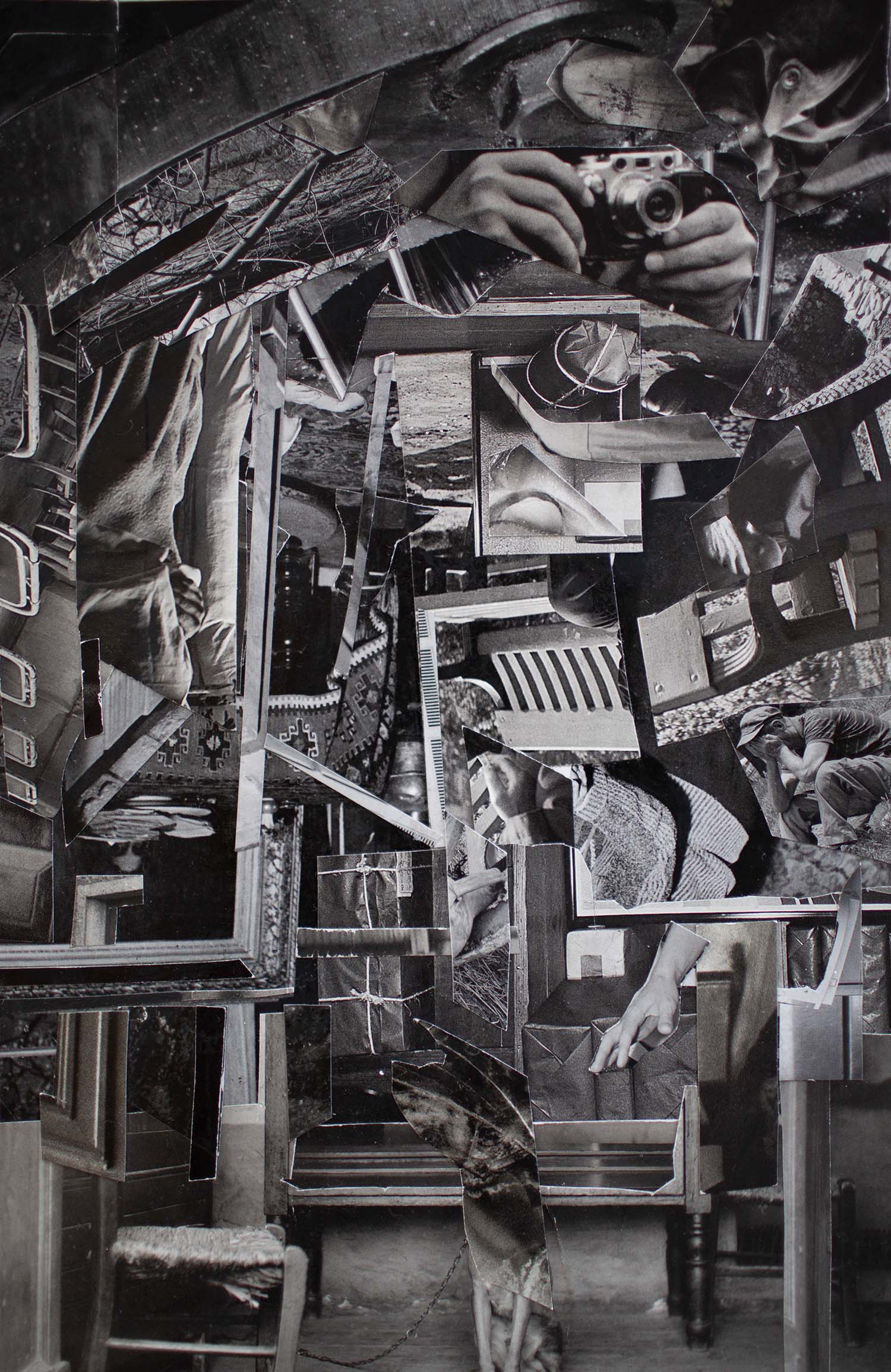
Sabine Hertig, Untitled, 2025. Analogue collage on paper, 28 × 18cm. © Sabine Hertig.
The Kunstmuseum Thun holds more than 400 of Gerber’s works, most of them donated by Walter in the 1980s, and the bulk have not been shown together since 1980. Curators Cornelius Krell and Anja Seiler treat the exhibition as a rediscovery as much as a display, a body of work that has waited more than forty years for anyone to look at it properly again.
Hertig works at the opposite end of collage’s range. Born in Basel in 1982 and trained at the city’s Academy of Art and Design, she has built, since 2010, large-format, mostly black-and-white worlds out of thousands of clipped fragments: newspapers, magazines, anything with a printed surface, layered until the source material dissolves into landscape. Represented by Galerie Stampa in Basel since 2013 and Galerie C in Paris since 2022, she treats collage as a way of thinking as much as a technique: a method for holding the fragment and the whole in view at once. Her second monograph is titled The Space of Fragments, and the same title now belongs to a documentary by filmmaker Angelo A. Lüdin, tracing the development of her work across collage, drawing and painting. It premieres at Kino Rex on 3 September, midway through the exhibition’s run.
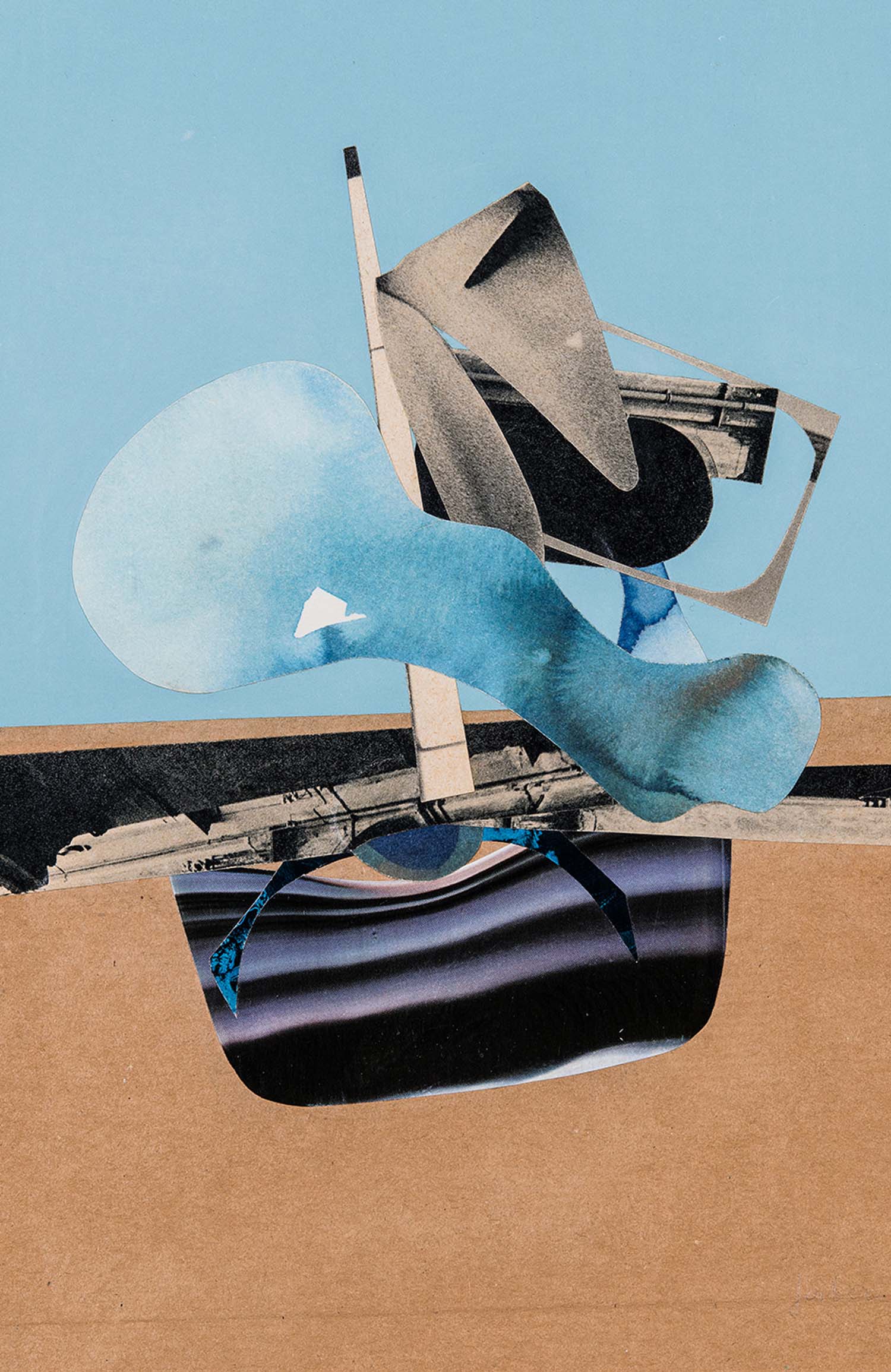
Hans Gerber, Collage 71/933, 1971. Collage on paper, 26 × 19 cm. Kunstmuseum Thun, Nachlass Hans Gerber. © Nachlass Hans Gerber.
Collage has been doing this kind of work since the 1910s, when cutting and pasting was still an avant-garde provocation. What Interfaces of Sight suggests, without spelling it out, is that the medium’s real subject has always been the seam, the place where one image stops and another begins, left for the eye to close. In a moment when so much of daily life already arrives pre-assembled, from feeds and scans and screenshots, watching two artists build meaning out of torn paper reads less like a historical footnote than a diagnosis.
The exhibition rooms keep an open collage workshop running for the length of the show, so the urge to reach for scissors doesn’t have to wait for the gift shop. Beyond the main galleries, the museum’s Thun Panorama outpost in Schadaupark is worth the walk on its own: Switzerland’s oldest panoramic painting, sketched by Marquard Wocher from a rooftop in the Old Town in 1814, still circles its rotunda, currently joined by Susanne Keller’s Hinterkammer des Auges.
The details
Exhibition: Interfaces of Sight. Hans Gerber and Sabine Hertig, Kunstmuseum Thun, 22 August – 29 November 2026.
Vernissage: Friday, 21 August, from 6:30pm. Welcoming remarks at 7pm from museum director Helen Hirsch, curators Cornelius Krell and Anja Seiler, and Vice Mayor Katharina Ali-Oesch, head of the city’s Department for Education, Sport and Culture — followed by an aperitif with DJ Maja.
For families: a free children’s vernissage runs alongside the opening (6:45–7:45pm, age 5+, no adult required); further creative workshops for children run several Saturdays through the autumn (5 September, 17 October, 28 November; CHF 5 plus admission).
Concerts: Bern double bassist Mich Gerber (no relation) performs Drifting Clouds live on 21 October, doors at 7pm (tickets via mokka.ch/event/mich-gerber-im-kunstmuseum). The show closes on 29 November with a matinée led by violinist Gwendolyn Masin and Sabine Hertig, in which the GAIA Chamber Orchestra plays Caroline Shaw and Schubert.
Talks & readings: the Hertig documentary premieres at Kino Rex on 3 September; the artist discusses her joint video work with Dirk Koy on 14 October; a guided tour on 18 October features people who knew Hans Gerber personally; and on 8 November, actors Bodo Krumwiede and Samuel Streiff give a staged reading of the correspondence between Gerber, his partner Hans Walter, and the painter Rudolf de Crignis.
Casual & ongoing: lunchtime gallery talks with Adrien Rihs, lunch available after at Café Thunerhof; Wednesday-evening life drawing, “Drink’n’Draw” (18+, by donation); free Ukrainian- and Russian-language drawing sessions led by artist Olga Sabadin (age 8+); and an open collage workshop inside the exhibition rooms for the length of the run. Further workshops, family sessions and mindfulness evenings run through the autumn — full listings from the museum.
images COURTESY
author PRIYAM MISHRA