
4 July, 2026
Everything Everywhere All at Once: Cruising Through Art Basel 2026
Every June, Basel performs its favorite magic trick: convincing thousands of people that spending seven figures on a work of art is perfectly reasonable, while paying CHF 10 for a coffee somehow feels outrageous. Yet beyond the champagne-fueled vernissages, discreet air kisses, and the annual migration of black-clad collectors across the Messeplatz, Art Basel 2026 revealed something deeper about the state of contemporary culture. The art world found itself in a surprisingly reflective mood.
This year’s fair felt like a collective therapy session. There was little interest in sugarcoating uncomfortable realities. Instead, artists, curators, and collectors engaged in conversations that have become difficult to avoid: war, the weakening of democratic values, environmental anxiety, and a growing crisis of meaning.
After years of NFT euphoria, AI panic, and a cooling market, the conversation shifted from disruption to durability. Collectors slowed down. Institutions leaned in. The market seemed less interested in hype and more interested in substance—a radical gesture in an economy increasingly built on visibility and attention.
And yet, the future was everywhere.
If previous editions of Art Basel asked whether technology could make art, this year’s edition posed a far more unsettling question: what happens when technology begins to shape the way we see reality itself? The most compelling works were not necessarily about technology; they were about perception, memory, identity, and what remains distinctly human in a world increasingly mediated by machines.
Perhaps the most striking trend was a renewed fascination with experience. Monumental installations, immersive environments, and site-specific interventions drew crowds because they offered something increasingly rare: a direct encounter.
Every year, a handful of works cut through the noise at Art Basel—the ones that stayed with me long after I’d left the fair.
One of the most compelling was Nikita Kadan’s Tryvoha (The Sirens and the Mast).
Presented by Voloshyn Gallery, the installation transforms one of the most recognizable sounds of contemporary Ukraine—the air-raid alarm—into the voice of an opera singer. Visitors step inside a translucent architectural structure and become physically enveloped in sound. The effect is profoundly unsettling. Kadan forces viewers to confront the uncomfortable distance between experiencing war and observing it. The work speaks to a paradox of contemporary media: we consume images of conflict daily, yet remain protected from its reality. Here, beauty and terror occupy the same frequency. The opera singer’s voice becomes both warning and lament, transforming collective trauma into a shared sensory experience.
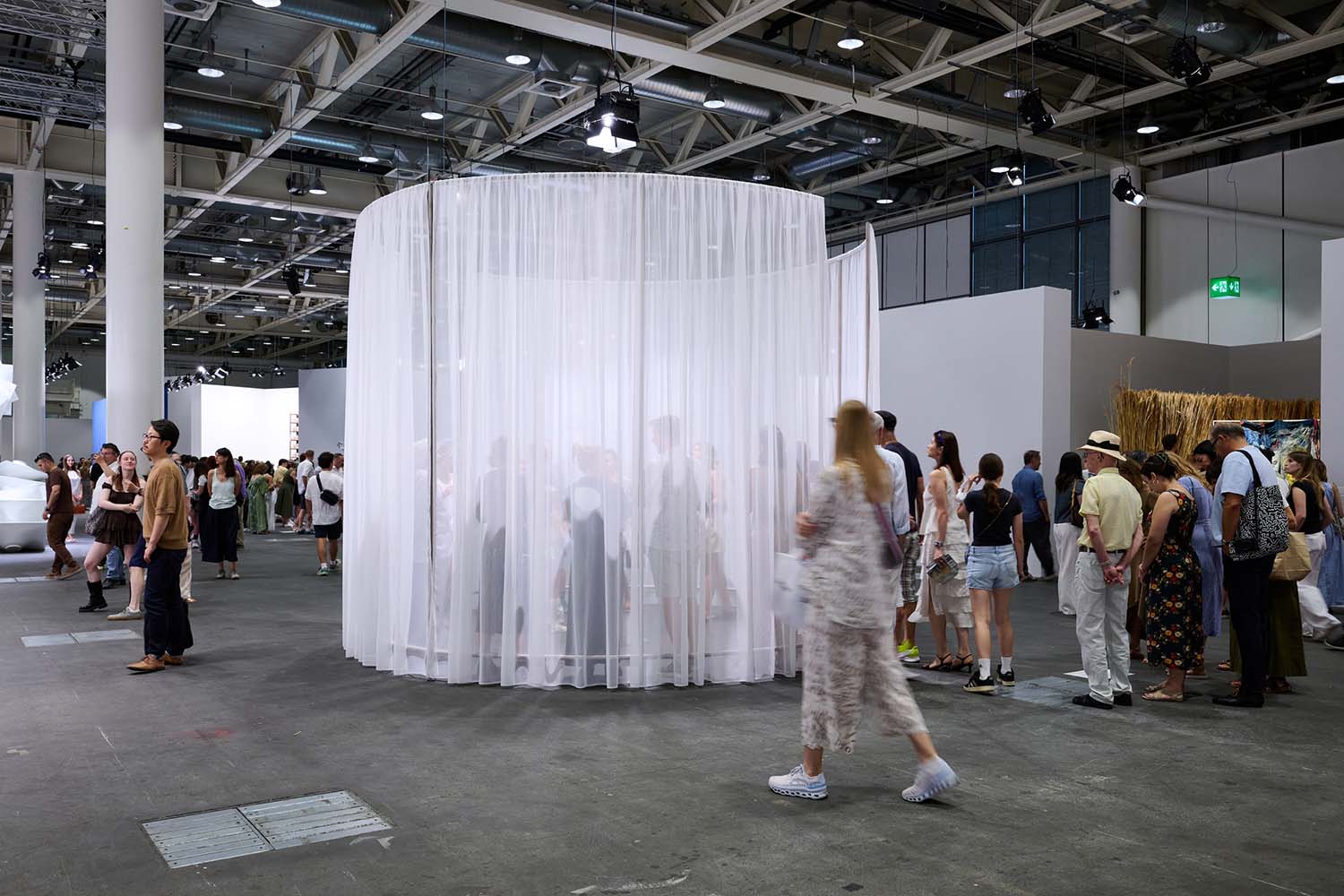
Image COURTESY OF ART BASEL
Nearby, Tuan Andrew Nguyen’s Repercussions offered one of the most moving gestures of the entire fair. Constructed from decommissioned bomb shells recovered from centralVietnam—the site of one of history’s most devastating aerial bombardments—the sculpture transforms instruments of violence into resonant bells. When struck, they produce a healing frequency traditionally associated with meditation and restoration. Nguyen’s work is ultimately about transformation: how memory survives catastrophe, how communities metabolize trauma, and how history might be reimagined.
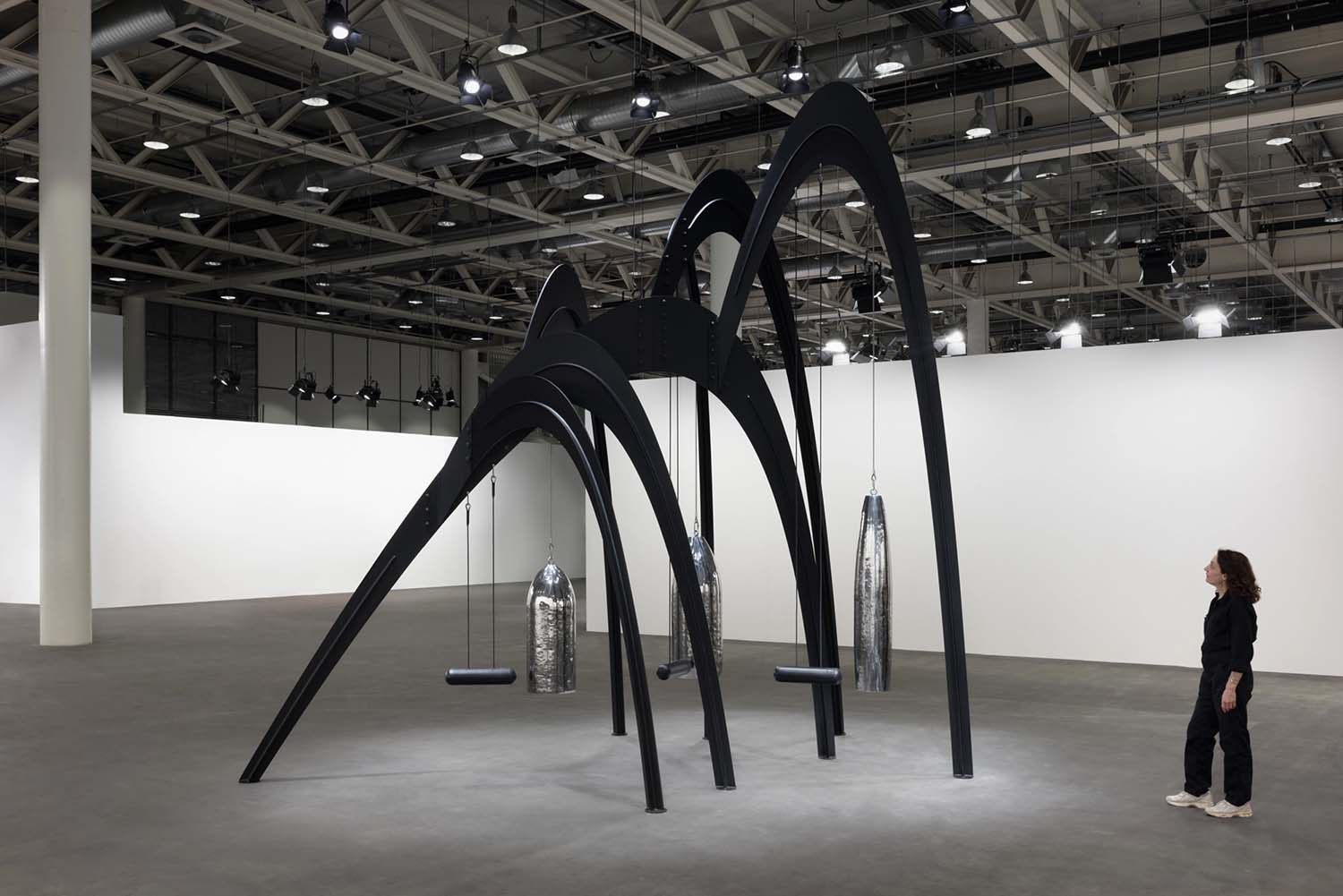
Image COURTESY OF ART BASEL
Equally striking was Oskar Schlemmer’s Homo, Composition in Metal, a work conceived nearly a century ago yet strangely at home in 2026. The Bauhaus master’s skeletal figure appears suspended between sculpture, architecture, and machine. Constructed from elegant metal lines, the body becomes a geometric proposition rather than an anatomical fact. Looking at it today, one cannot help but think about our increasingly mediated existence. Long before algorithms, avatars, and digital identities, Schlemmer was already asking what remains human when the body is translated into systems, structures, and codes.
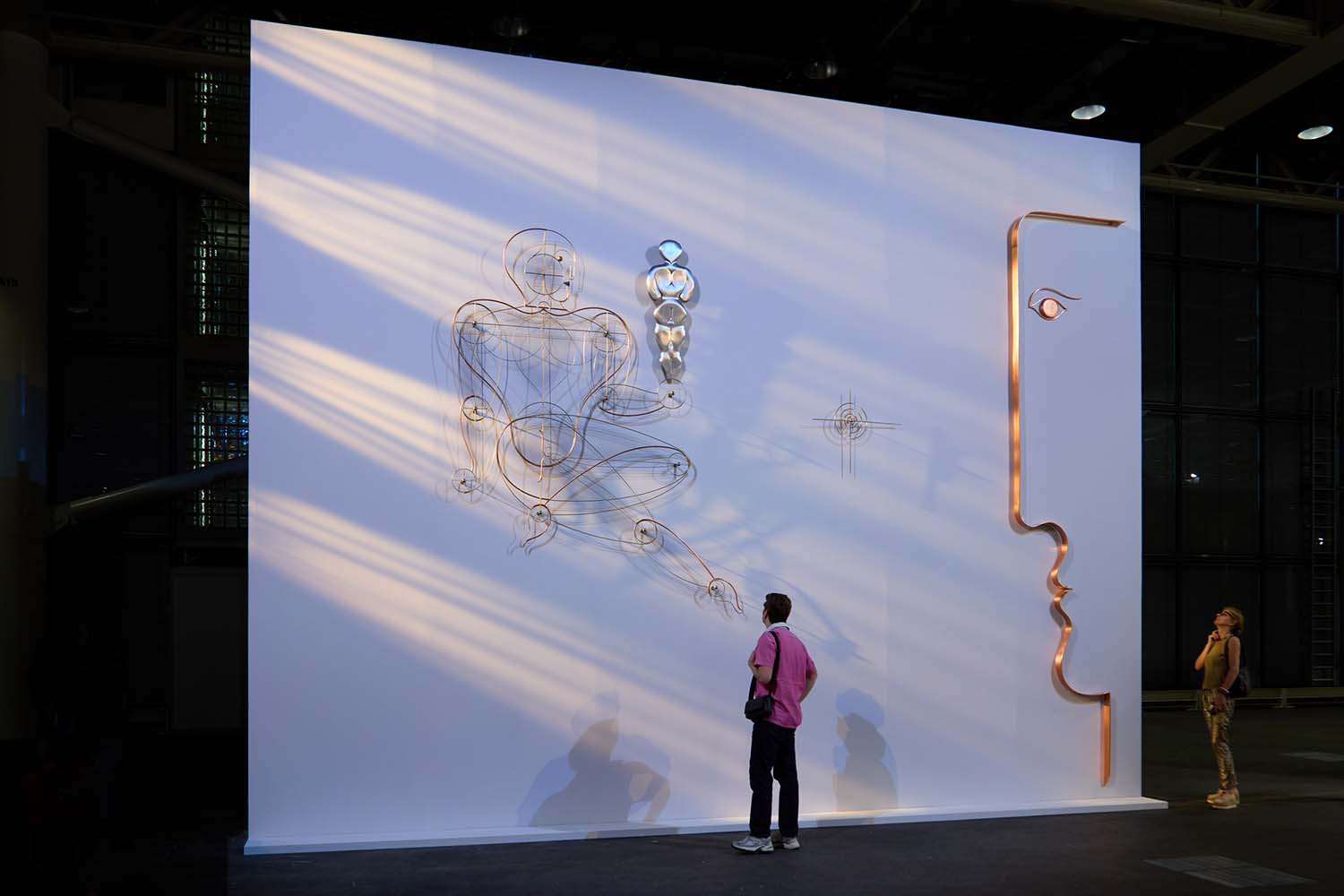
Image COURTESY OF ART BASEL
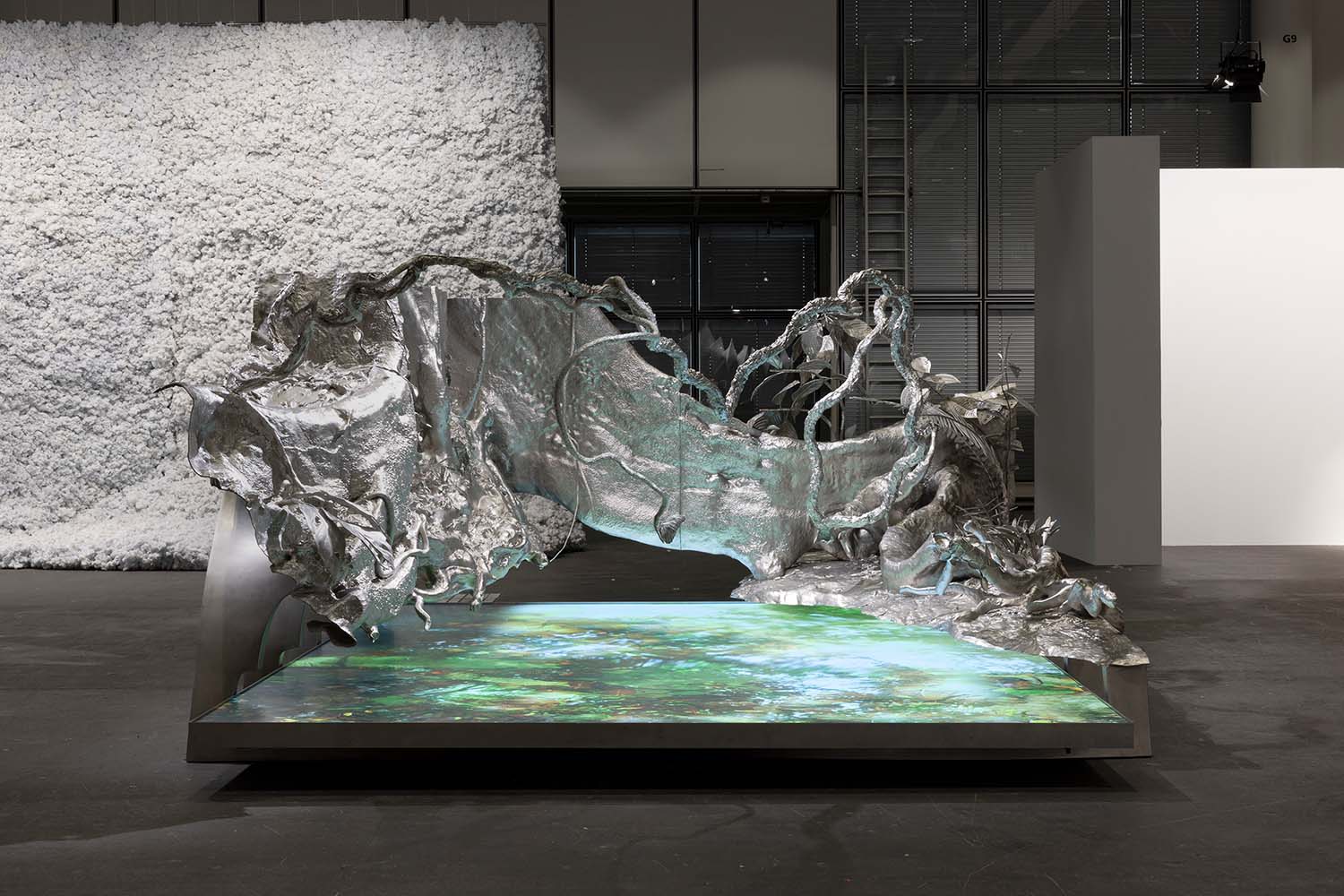
Questions surrounding humanity’s relationship with nature surfaced repeatedly throughout the fair, finding one of their most poetic expressions in Timur Si-Qin’s Mariposita. Suspended between sculpture and ecosystem, the installation combines steel structures, moving imagery, plant life, and organic forms into a fragile environment that feels simultaneously ancient and futuristic. The work imagines a world where distinctions between the natural and the synthetic have dissolved. Rather than presenting nature as something separate from humanity, Si-Qin proposes a vision of deep entanglement between the two.
Image COURTESY OF ART BASEL
Another unforgettable encounter came in the form of Vanessa Beecroft’s Untitled (Izaname) (2026), presented by Lia Rumma. The installation extends a 25-minute film into physical space, in which one set from the film becomes part of the work itself. It is composed of a film with sound, five white plaster sculptures—Lying Body, Waist Fragment, Leg Fragment, Lying Torso Fragment, and Standing Torso Fragment—alongside a hospital bed, chair, and lamp. Featuring Bianca Censori as Izaname, the film draws on the myth of Persephone’s descent into Hades, reimagined in a large, semi-abandoned hotel near Tokyo. Set in Japan yet echoing Greek mythology, it unfolds through ritual, confinement, and transformation, suggesting a final passage and a form of identity shaped through darkness.
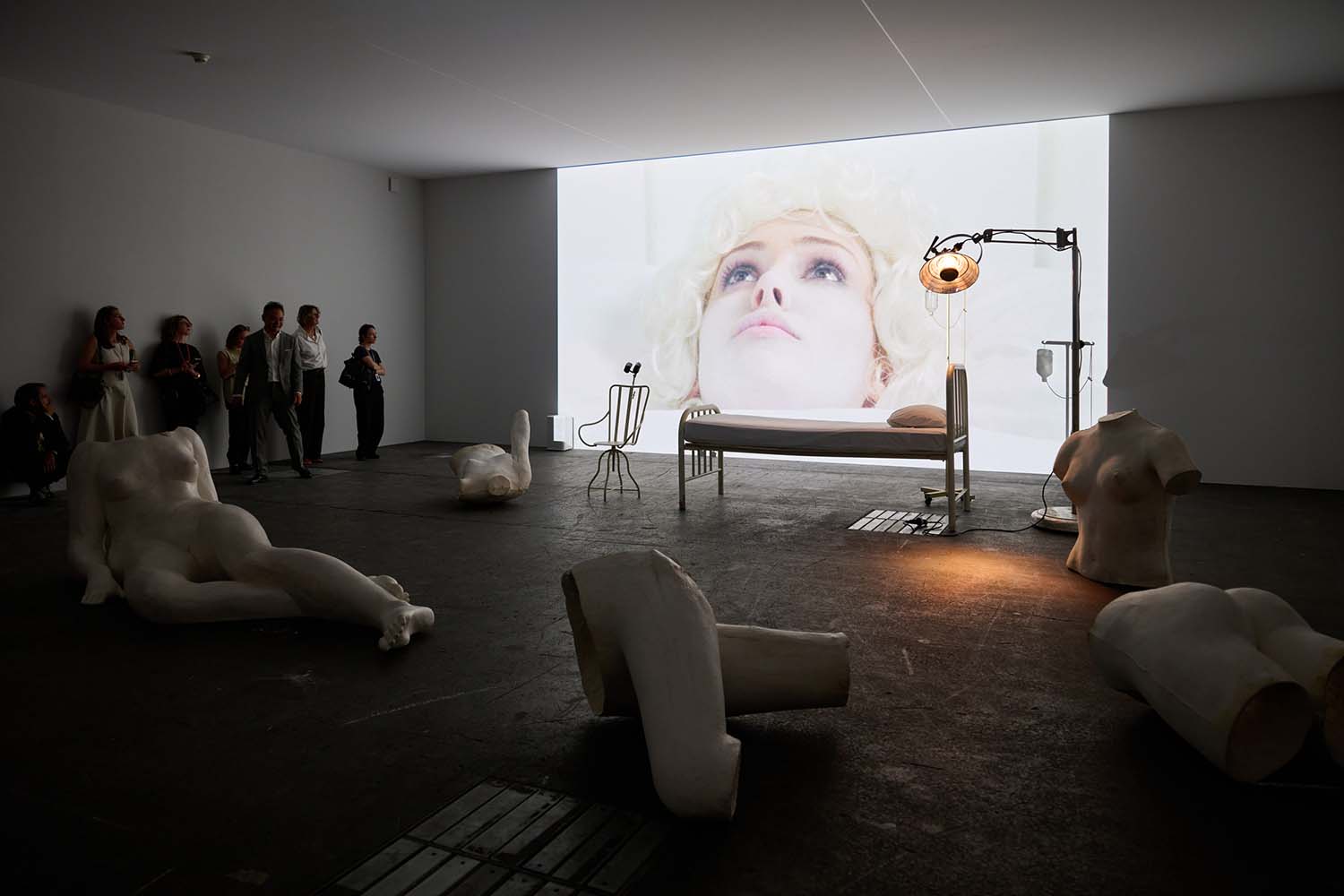
Image COURTESY OF ART BASEL
Just as powerful was Rochelle Goldberg’s precious stones. At first glance, the work resembles a fallen monument or fragmented body. Yet the longer one spends with it, the more complex it becomes. Goldberg draws together references to Mary Magdalene, pin-up culture, reproduction, devotion, and decay, constructing a sculpture that resists easy interpretation. The tower, traditionally associated with power and permanence, collapses into vulnerability. Historical archetypes of femininity fracture under their own symbolic weight. The work asks: how many times can an image be resurrected before it loses its meaning entirely?
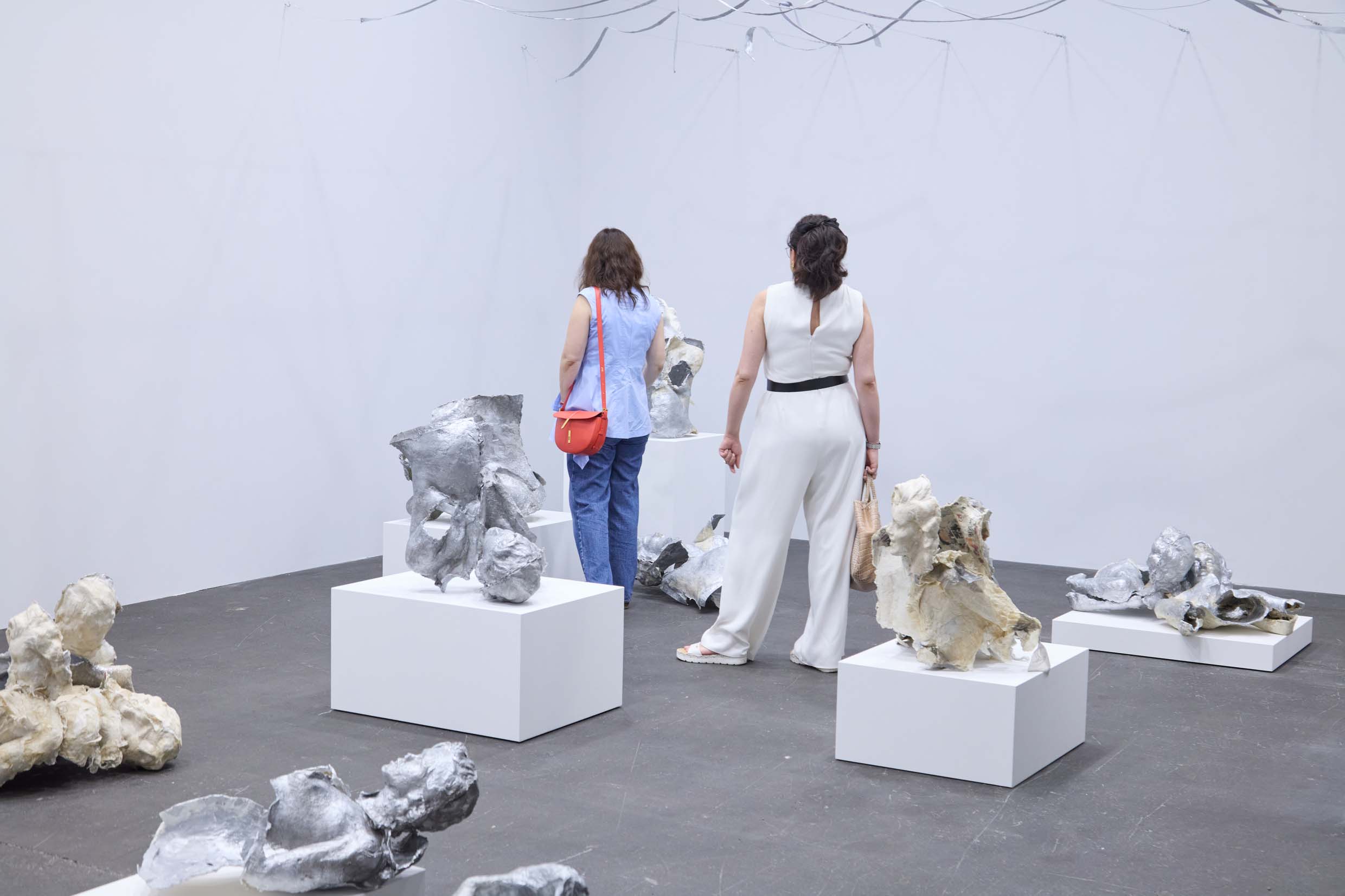
Image COURTESY OF ART BASEL
Taken together, these works offer a portrait of contemporary life in which multiple realities coexist. One moment you are confronted with conflict, the next with beauty; one moment with ecological anxiety, the next with the possibility of repair. Nothing is resolved. Nothing is neatly packaged. And perhaps that is the point.
To me, Art Basel 2026 offered a mirror—complicated, fragmented, sometimes uncomfortable, occasionally hopeful—a reminder that we are all learning to live with contradictions at the same time, in the same place, all at once.
Author ANASTASIA YOVANOVSKA